1. Introduction
1.1 The Propulsion Gap
The distances between the inner planets are not large by the standards of nuclear energy. Earth to Mars at opposition is roughly 0.5 AU; Earth to Jupiter is roughly 5 AU. Fusion reactions release approximately six orders of magnitude more energy per unit mass than chemical combustion. In principle, fusion-powered spacecraft could reduce interplanetary transit times from months to days, transforming space transport from expedition logistics to routine operations.
No fusion propulsion system has been built or tested at any scale. The reasons are partly engineering (plasma confinement, ignition thresholds, materials) and partly thermodynamic. This paper addresses the thermodynamic obstacle, which has received less systematic attention.
1.2 Why This Matters Now
The motivation for this work is grounded in a specific development: the rapid acceleration of autonomous research capability. The arrival of artificial general intelligence (AGI) and, in foreseeable succession, artificial superintelligence (ASI) will transform the pace of scientific and engineering research. Problems requiring decades of incremental human-led laboratory work may become tractable on timescales of years, once autonomous systems can design experiments, interpret results, and iterate without the bottleneck of human cognitive bandwidth.
Fusion ignition is one of the hardest remaining engineering problems. Proton-boron fusion, with its extreme ignition temperature (~300 keV), is harder still. But the difficulty is primarily a confinement and plasma control problem: exactly the kind of high-dimensional optimization where autonomous research systems are most likely to achieve rapid breakthroughs. Companies including TAE Technologies (field-reversed configurations), HB11 Energy (laser-driven approaches), and ENN (spherical torus) are already pursuing p-¹¹B fusion. The question this paper addresses is: assuming ignition is achieved, what performance regime does p-¹¹B open for propulsion, and is that regime worth targeting?
The answer matters for infrastructure planning. If p-¹¹B directed exhaust can deliver the performance estimated here, the downstream engineering (magnetic nozzle design, thermal management, fuel handling) should be studied in parallel with ignition research, not deferred until ignition is demonstrated. The propulsion architecture and the fusion core are separable problems. Solving them sequentially wastes the time advantage that accelerated research capability provides.
1.3 The Strategic Context
Multiple actors are building toward sustained human presence beyond Earth orbit. SpaceX’s Starship architecture targets launch costs enabling large-scale orbital and cislunar construction. Proposals for lunar and Martian industrial operations are advancing from concept to early engineering. The missing element is fast, efficient interplanetary transport. Chemical propulsion can reach Mars, but transit times (6–9 months) and mass ratios (>90% propellant) constrain mission architecture to the point where permanent industrial presence requires enormous logistical overhead.
A propulsion system delivering ~0.4g continuous acceleration with propellant fractions below 35% would change this calculus. Transit times to Mars drop to days. Jupiter becomes reachable in weeks. The asteroid belt, Jovian moons, and outer solar system become accessible for industrial operations.
A particularly relevant application is the establishment of autonomous research laboratories in interplanetary locations: orbital platforms, lunar facilities, or asteroid-based installations conducting materials science, pharmaceutical development, and manufacturing process optimization. Servicing these facilities requires transport that is fast (minimizing downtime), efficient (minimizing operating cost), and scalable (supporting multiple facilities simultaneously). The propellant fractions estimated in this paper (28–31%) are compatible with routine, reusable transport in a way that conventional fusion concepts (60–97% propellant) are not.
The convergence is specific: ASI-enabled research labs solve the ignition problem; directed exhaust architecture converts that solution into propulsion performance; and that performance enables the interplanetary industrial infrastructure that justifies the investment. Each link requires research now, because the timeline for AGI/ASI arrival is measured in years, not decades.
1.4 Scope and Limitations
This is a concept paper, not a design study. It identifies a performance regime, argues that the physics permits it, estimates its parametric sensitivity, and specifies what further work is needed. It does not present transport simulations, particle-tracing results, or engineering designs. Quantitative estimates should be understood as defining a target design space, not predicting system performance.
The central claim is narrow: p-¹¹B fusion products have an entropy structure qualitatively more favorable for direct magnetic collimation than thermal plasmas, and this has not been properly exploited or clearly articulated in the existing literature.
2. Theoretical Framework
2.1 Liouville’s Theorem and Propulsion
A system of N particles in three dimensions occupies a volume in 6N-dimensional phase space. Liouville’s theorem states that the phase space density is constant along Hamiltonian trajectories:
The volume occupied by a collection of particles in phase space is invariant under lossless dynamics. The standard conclusion is that fusion exhaust cannot be collimated without dissipating entropy or discarding particles.
This conclusion is correct about full phase space volume. But propulsion does not require compression of all phase space dimensions. It requires only that momentum vectors align along the thrust axis. The spatial distribution of the exhaust is irrelevant to thrust. This distinction is routine in accelerator physics (beam emittance trades) but has not been systematically applied to fusion propulsion.
2.2 Phase Space Structure of p-¹¹B Products
The proton-boron fusion reaction:
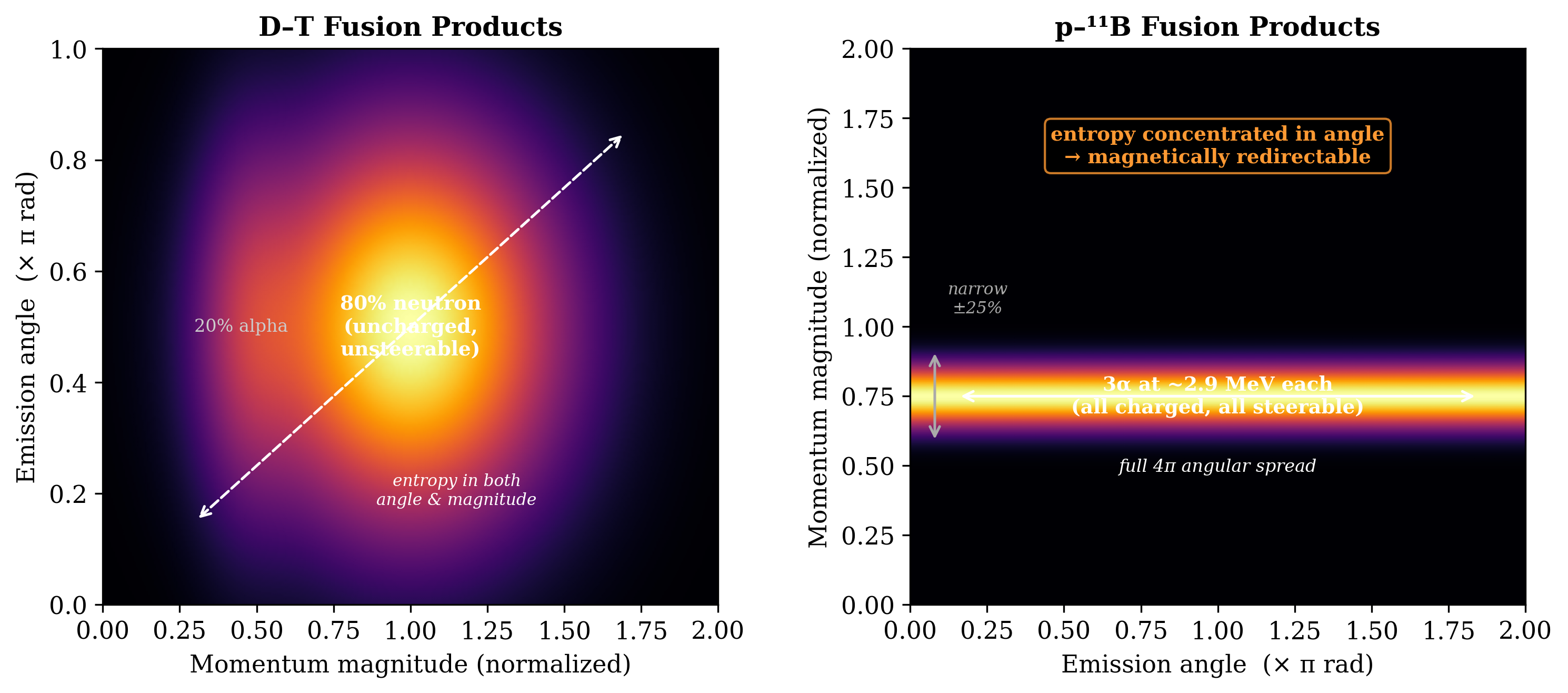
produces three alpha particles (rest mass 3727.4 MeV/c² each) sharing 8.7 MeV of kinetic energy. The reaction proceeds predominantly through an intermediate ⁸Be* state: one alpha is emitted promptly with high energy (~4–5 MeV), and the remaining ⁸Be* decays into two alphas at lower energy (~1.5 MeV each). The resulting energy distribution is not Gaussian but bimodal, with structure visible in the Dalitz plot.[16, 17] The mean kinetic energy per alpha is approximately 2.9 MeV, but individual alphas span a range from roughly 1.5 to 5 MeV.
This bimodal structure has a specific consequence for collimation: the high-energy prompt alpha (~5 MeV) has a larger Larmor radius than the ⁸Be* decay alphas (~1.5 MeV) by a factor of roughly \(\sqrt{5/1.5} \approx 1.8\). It will therefore reach the adiabatic breakdown threshold (\(\varepsilon \approx 1\)) earlier in the nozzle expansion, detaching at a lower effective mirror ratio with a wider pitch angle. The exhaust is not a single population with ±25% spread; it is two populations with different collimation characteristics. The directional efficiency estimates in Section 4 should be understood as averages over this bimodal distribution, and the actual performance will depend on the relative weighting of the prompt and sequential channels. Proper quantification requires particle tracing using the measured differential cross-sections[16, 17] as initial conditions.
The mean velocity for a 2.9 MeV alpha is:
Despite the bimodal energy structure, the velocity spread remains qualitatively different from a Maxwellian plasma: the alphas occupy a bounded energy range (1.5–5 MeV) rather than the factor-of-several spread typical of thermal distributions. The angular distribution is approximately isotropic (4π steradians) in the lab frame. The occupied phase space decomposes schematically as:
where \(\Delta p_r\) (momentum magnitude spread) is narrow relative to the mean, while \(\Delta\Omega\) (solid angle) approaches its maximum. The entropy is dominated by the angular term. This is the key observation: the phase space is concentrated in the angular subspace, which is exactly the subspace magnetic fields act on.
2.3 The Collimation-Position Trade
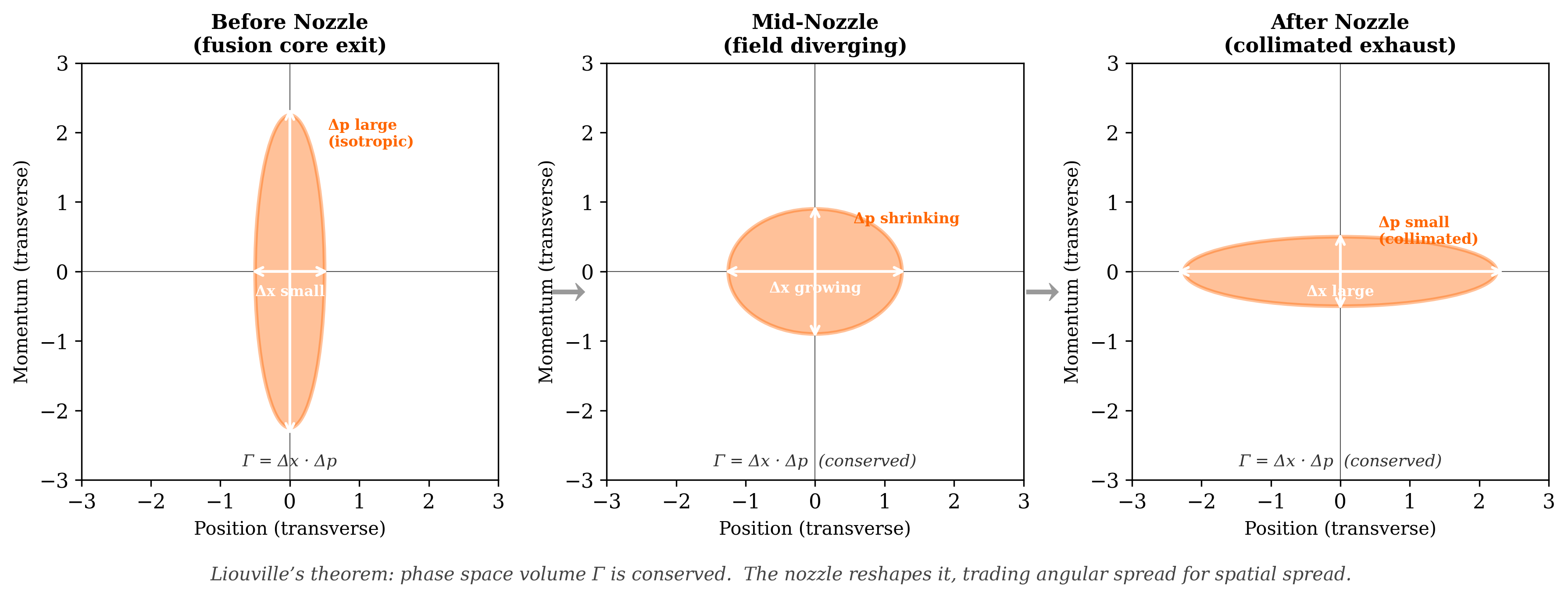
A diverging magnetic field redirects charged particle trajectories through conservation of the adiabatic invariant (magnetic moment \(\mu = mv_\perp^2/2B\)). As particles enter weaker field regions, transverse velocity converts to parallel velocity while the spatial distribution broadens:
For propulsion this trade is favorable: thrust depends on total axial momentum flux integrated over the exhaust cross-section, and a spatially broad but well-collimated exhaust delivers the same thrust as a narrow one.
2.4 Adiabatic Limits and Detachment
The adiabatic invariant is conserved only when the field varies slowly over a single Larmor orbit. The adiabaticity parameter is:
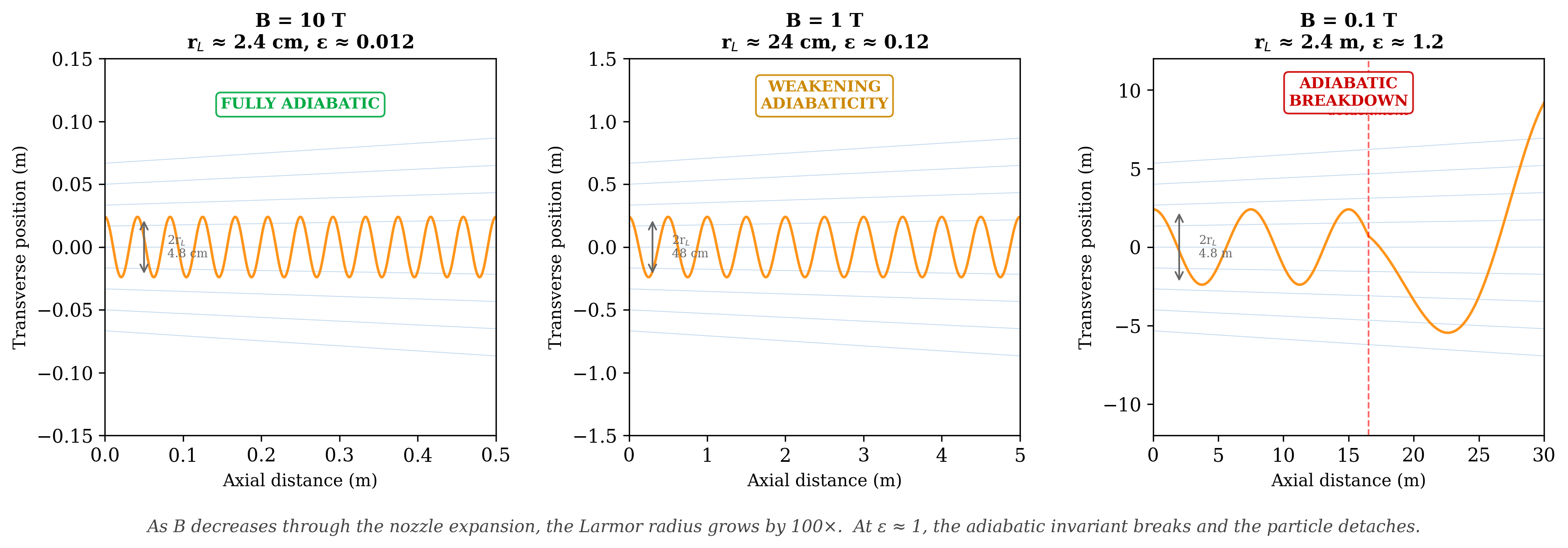
where \(r_L\) is the Larmor radius and \(L_B = |B/\nabla B|\) is the field gradient scale length. Adiabaticity requires \(\varepsilon \ll 1\). For a 2.9 MeV alpha (He²⁺), the magnetic rigidity gives:
where \(B\) is in Tesla. At a nozzle throat field of 10 T, \(r_L \approx 2.4\) cm and the particle is well-confined. As the field drops through the expansion, the Larmor radius grows. For a nozzle with gradient scale length \(L_B \approx 2\) m:
- At 10 T: \(r_L \approx 0.024\) m, \(\varepsilon \approx 0.012\). Fully adiabatic.
- At 1 T: \(r_L \approx 0.24\) m, \(\varepsilon \approx 0.12\). Adiabaticity weakening but collimation still effective.
- At 0.1 T: \(r_L \approx 2.4\) m, \(\varepsilon \approx 1.2\). Adiabatic invariant broken. Particle detaches.
This analysis yields an effective mirror ratio of approximately \(R \approx 10\) (from 10 T throat to ~1 T detachment region) before non-adiabatic effects dominate. Beyond this point, particles go ballistic with whatever pitch angle they have at detachment.
2.5 Detachment Physics
The detachment process has two important characteristics that refine the idealized picture:
Gyrophase dependence. At \(\varepsilon \approx 1\), the particle’s final pitch angle depends on its gyrophase at detachment. The result is a statistical spread around the mean detachment angle, not a clean cutoff. However, the particle retains the bulk of the parallel momentum it accumulated in the strong-field region. Detachment does not reverse collimation; it freezes it at a non-ideal but useful point.
Velocity-dependent smearing. Particles born with different ratios of perpendicular to parallel velocity detach at different field strengths. Low-\(v_\perp\) particles (born nearly parallel to the axis) have small Larmor radii and remain adiabatic deeper into the expansion, achieving excellent collimation. High-\(v_\perp\) particles detach earlier at lower effective mirror ratios. The exhaust angular distribution is therefore smeared: a superposition of well-collimated and less-well-collimated populations. For an initially isotropic distribution, this smearing degrades the directional efficiency below the idealized single-particle estimate.
Both effects reduce the directional efficiency from the idealized adiabatic prediction but do not eliminate the collimation advantage. The net effect is to bound the realistic directional efficiency to approximately 0.70–0.90, compared to the idealized 0.90–0.95 from the simple mirror formula.
3. System Architecture (Conceptual)
3.1 Fusion Core
The fusion core must sustain p-¹¹B reactions at temperatures exceeding 300 keV. No existing confinement concept has demonstrated net energy gain from p-¹¹B. The entire propulsion concept is conditional on this capability. Several approaches are under active development: TAE Technologies (field-reversed configurations), HB11 Energy (laser-driven ignition), and ENN (spherical torus).
A critical requirement is extraction of alpha products before thermalization. If the alphas equilibrate with the bulk plasma, the phase space advantage is lost. The relevant comparison is between the thermalization timescale and the transit time through the confinement region.
The Spitzer slowing-down time for a fast ion in a background plasma is approximately:
For 2.9 MeV alphas in a p-¹¹B plasma at electron temperature \(T_e \approx 300\) keV and density ~10²⁰ m⁻³, the thermalization timescale is of order 10–100 μs. The transit time for a 0.039c alpha through a ~1 m confinement region is approximately 0.1 μs. The alphas therefore have two to three orders of magnitude of margin to exit the confinement region before significant energy exchange with the bulk plasma.
This margin is not unlimited. At higher plasma densities or longer confinement path lengths, thermalization becomes competitive with extraction. But for open-field-line geometries (mirrors, FRCs with open ends) where energetic products naturally escape along field lines, the timescale separation is favorable. The large Larmor radius of MeV alphas relative to the confining field structure further promotes decoupling from the bulk plasma.
3.2 Magnetic Nozzle
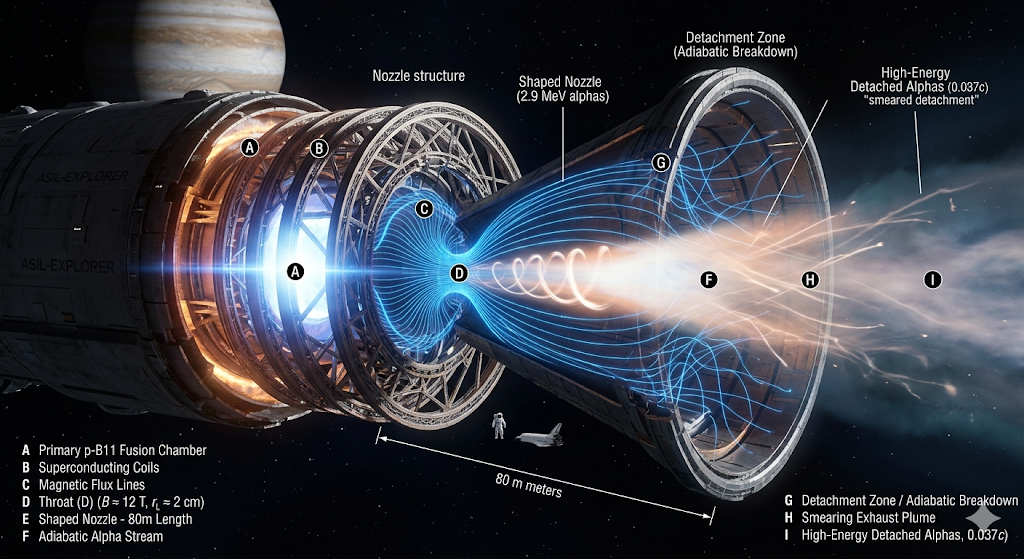
The magnetic nozzle converts angular spread to axial alignment. The mirror force:
acts on particles with transverse velocity. Under the adiabatic approximation, the limiting half-angle is:
As established in Section 2.4, the effective mirror ratio for 2.9 MeV alphas is bounded at approximately \(R \approx 10\) for nozzle gradient scale lengths of ~2 m, giving a mean half-angle of ~18° and directional efficiency of ~0.90 before accounting for smearing effects.
Two additional effects modify the single-particle picture. First, electrons remain magnetized much longer than alphas (their Larmor radius is smaller by a factor of ~85), creating an ambipolar electric field as the charge populations separate. This is the well-studied electron detachment problem in magnetic nozzle physics.[23, 24] The ambipolar field accelerates ions and decelerates electrons until they detach together, introducing corrections of order a few percent to the single-particle thrust estimates. Second, the plasma beta (\(\beta = P_\text{kinetic}/P_\text{magnetic}\)) varies along the nozzle. At the 10 T throat, \(\beta \approx 0.06\) and the magnetic field dominates, validating the single-particle adiabatic analysis. As the field drops through the expansion, \(\beta\) rises above unity in the detachment zone, consistent with the transition from magnetically guided to ballistic exhaust. The high-\(\beta\) regime at detachment does not invalidate the concept; it partially defines the detachment surface.
3.3 Contrast with Prior Work
The closest prior work in the academic literature is Tarditi’s NASA NIAC Phase I study.[12] Tarditi assumed an aneutronic source and investigated beam conditioning for propulsion. His architecture deliberately thermalizes the products: alphas are injected non-adiabatically into a magnetic duct, transfer energy into gyro-motion, and heat a denser propellant expanded through a magnetic nozzle. This is a fusion-heated thermal rocket.
In the informal literature, MatterBeam’s ToughSF analysis[22] is the most detailed public attempt to explain the Epstein Drive from The Expanse using real physics. That analysis uses D-He3 fuel with inertial confinement (laser-ignited pellets) and a modified VISTA architecture, achieving approximately 75% thrust efficiency through shaped fusion charges and magnetic redirection. The ToughSF treatment is valuable as an engineering feasibility sketch but differs from the present work in three respects: it uses D-He3 rather than p-¹¹B (retaining some neutron production from D-D side reactions), it does not address the phase space structure of the products or the Liouville constraint, and it does not quantify the adiabatic limits on magnetic collimation.
The approach proposed here is distinct from both: preserve the non-thermal character of p-¹¹B products and redirect them directly, avoiding both thermalization (Tarditi) and shaped-charge inertial schemes (ToughSF). The phase space argument in Section 2 provides the theoretical basis for why direct redirection is favorable for p-¹¹B specifically. To our knowledge, this argument has not been made in the prior literature.
4. Parametric Estimates
The following estimates define the target design space. They are not predictions. Each depends on assumptions that require validation through simulation.
4.1 Effective Exhaust Velocity
Directional efficiency \(\eta_d\) represents the fraction of exhaust kinetic energy contributing to axial thrust:
For \(v_\alpha = 0.039c\):
| Scenario | \(\eta_d\) | \(v_e\) |
|---|---|---|
| Idealized (\(R=50\)) | 0.95 | 0.038c |
| Adiabatic limit (\(R\approx10\)) | 0.90 | 0.037c |
| With smearing effects | 0.70–0.85 | 0.033–0.036c |
4.2 Comparison with D-T
For propulsion, the relevant metric is directed energy: how much reaction energy converts to steerable axial momentum.
D-T releases 17.6 MeV, but 80% (14.1 MeV) goes to an uncharged neutron. The steerable alpha carries 3.5 MeV. In terms of rest mass, the directed fraction is approximately \(0.20 \times 0.378\% \approx 0.076\%\).
p-¹¹B releases 8.7 MeV, 100% in charged products. The directed fraction is \(100\%\) of \(0.078\% \approx 0.078\%\).
The two fuels produce comparable directed energy per unit fuel mass. But D-T additionally requires neutron shielding, thermal conversion hardware, radiators, and a secondary propulsion system. A fair comparison requires a full system mass model, which this paper does not provide. The p-¹¹B advantage may be primarily in system simplicity rather than raw energy metrics.
| Parameter | D-T | p-¹¹B |
|---|---|---|
| Total energy | 17.6 MeV | 8.7 MeV |
| Mass-energy conversion | 0.378% | 0.078% |
| Charged fraction | 20% | 100% |
| Directed energy (% rest mass) | ~0.076%* | ~0.078%† |
| Neutron shielding | Significant | Negligible |
| Thermal conversion | Required (80%) | Not required |
* Before thermal conversion losses. Actual directed fraction after Carnot cycle is lower.
† Before nozzle collimation losses. Actual directed fraction depends on \(\eta_d\).
4.3 Mass Ratio Estimates
For a 10-day Earth-Jupiter brachistochrone (\(\Delta v \approx 0.012c\)):
| Scenario | \(v_e\) | Propellant % |
|---|---|---|
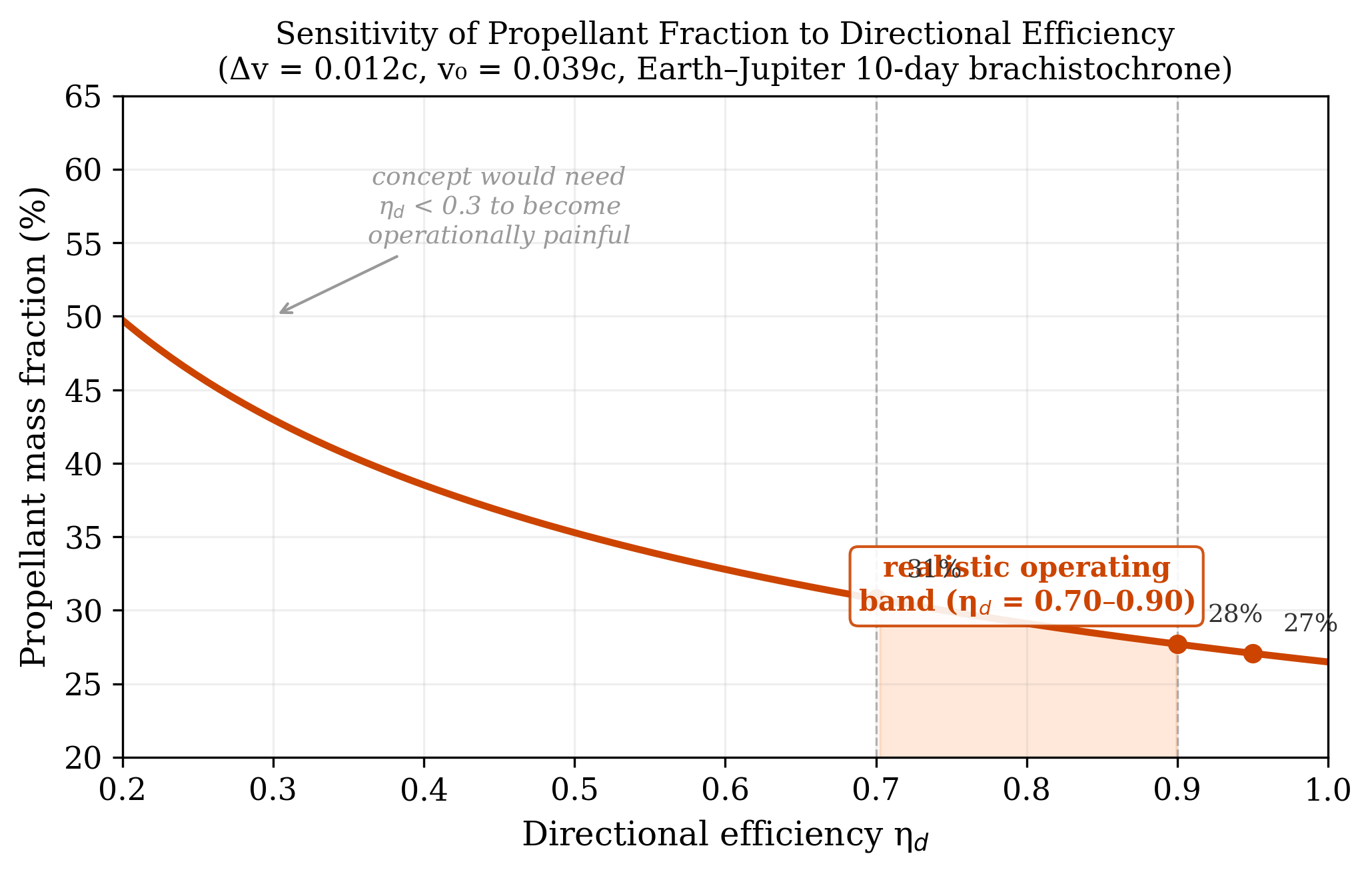
| Idealized | 0.038c | 27% |
| Adiabatic limit | 0.037c | 28% |
| With smearing | 0.033–0.036c | 28–31% |
| Severe degradation | 0.025c | 38% |
The concept is robust to the adiabatic breakdown identified in Section 2.4. The efficiency enters through a square root (\(\eta_d^{1/2} \rightarrow v_e\)), and the rocket equation is logarithmic in \(v_e\). These two layers of compression insulate the propellant fraction against moderate efficiency losses. The concept would require catastrophic degradation (\(\eta_d < 0.3\)) before propellant fractions become operationally prohibitive.
4.4 Power Requirements
The power requirement scales directly with the mission acceleration profile. For a 1000-tonne spacecraft:
30-day Earth-Jupiter transfer (~0.14g continuous): This near-term mission profile requires thrust of ~1.4 × 10⁶ N and jet power of approximately 0.8 TW. This is an enormous power level by current standards but falls within the range of conceivable future energy systems, particularly if fusion power density improves along the trajectory suggested by current research programs.
10-day Earth-Jupiter transfer (~0.43g continuous): The reference mission used throughout this paper requires thrust of ~4.2 × 10⁶ N and jet power of approximately 25 TW, comparable to twice the current global installed nuclear capacity. This represents the asymptotic performance limit of the concept, not a near-term target.
These power levels are inherent to the mission profiles, not specific to any propulsion technology. Any system delivering continuous high-g thrust at relativistic exhaust velocities must sustain comparable output. The propulsion architecture described in this paper does not change the power requirement; it changes the fraction of that power that becomes useful thrust.
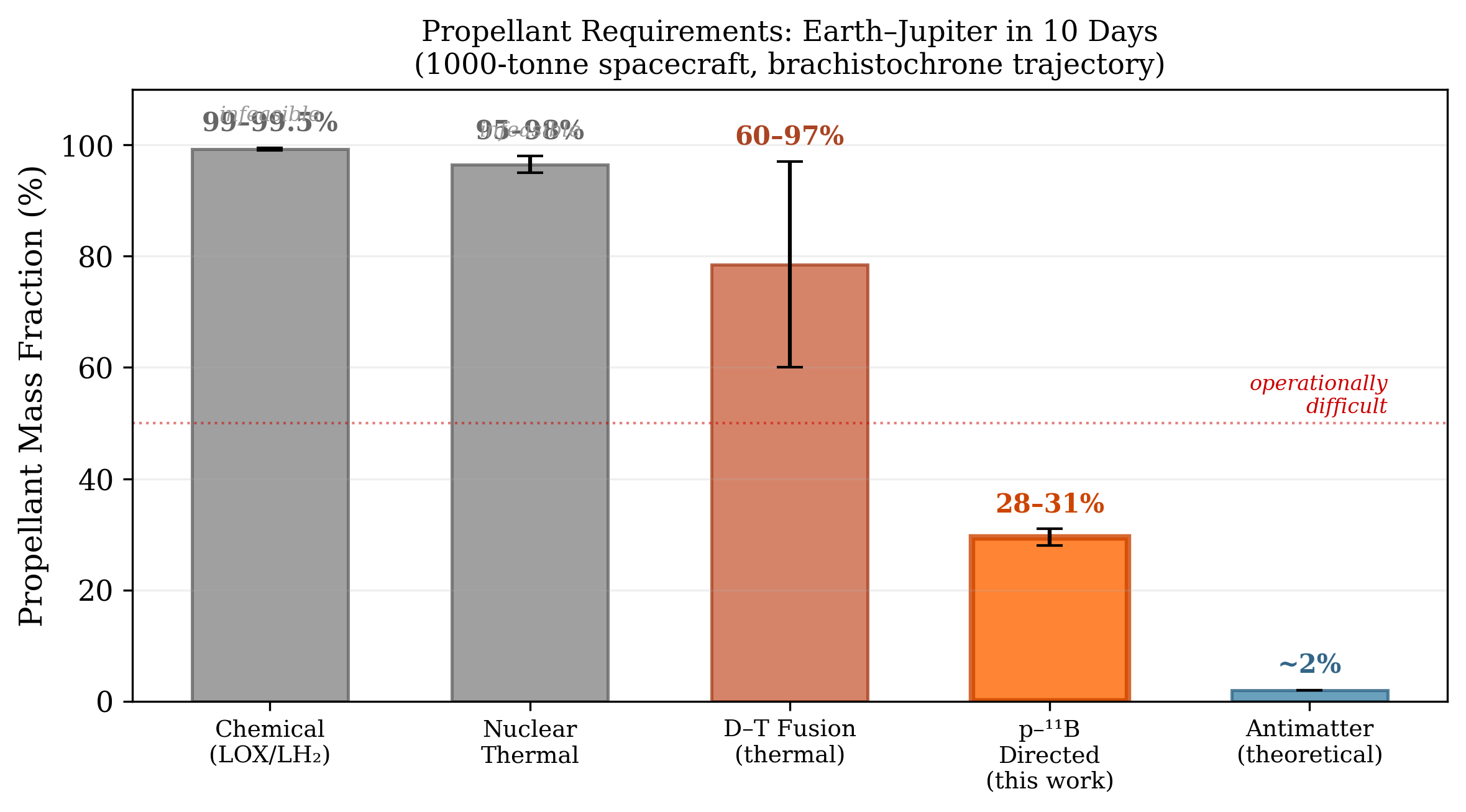
| System | Propellant Fraction |
|---|---|
| Chemical (LOX/LH₂) | >99% (infeasible) |
| Nuclear thermal | >95% (infeasible) |
| D-T fusion (thermal) | 60–97% |
| p-¹¹B directed exhaust (this paper) | 28–31% (estimated) |
| Antimatter (theoretical limit) | ~2% |
5. What This Paper Does Not Establish
The following are not established by the arguments in this paper:
Nozzle performance from simulation. No particle-tracing or PIC simulation has been performed. The adiabatic analysis in Section 2.4 provides order-of-magnitude bounds but does not capture non-adiabatic transition dynamics, loss cone effects, or the full velocity-dependent smearing of the detachment surface. The magnitude of performance degradation from these effects is unknown.
Bremsstrahlung budget. Proton-boron plasmas suffer significant bremsstrahlung losses due to boron’s atomic number (Z=5) and the high temperatures required for ignition. The bremsstrahlung power can approach or exceed fusion power under unfavorable conditions. This paper does not present a radiation loss budget. This is one of the most well-studied objections to p-¹¹B fusion and cannot be dismissed.
Three-body energy distribution. The alpha energy spread is characterized here as ~±25%. The actual distribution is governed by the Dalitz plot including ⁸Be resonance structure. Proper treatment requires the measured differential cross-section as initial conditions for particle tracing.
Thermalization avoidance. The concept depends on extracting products before thermalization. Whether this is achievable depends on confinement geometry, plasma density, and extraction mechanism. The paper asserts that open-field-line geometries are favorable but does not model the process.
System mass comparison. The directed-energy comparison (Table 2) is suggestive but incomplete. A fair comparison with D-T requires a full system mass model including shielding, conversion hardware, radiators, and structural mass.
Space charge limits. At the reference mission mass flow rate of 0.36 kg/s of He²⁺, the ion flux is approximately 5.4 × 10²⁵ ions/s, corresponding to a beam current of ~17 MA. Even distributed over a 100 m² cross-section, the current density is ~170 kA/m². At this scale, beam self-field effects and Child-Langmuir space charge limits are non-trivial and may compete with magnetic collimation. Whether co-moving electrons from the fusion plasma provide sufficient neutralization is unknown. This requires self-consistent PIC simulation (see Section 6.3) and is not resolved by the present analysis.
6. Proposed Research Program
If the concept is to be validated or falsified, the following work is required. The autonomous research paradigm described here represents a singular convergence of timing and capability that may not recur in this form.
6.1 Particle-Tracing Simulation (Highest Priority)
A particle-tracing simulation using the actual three-body energy and angular distribution through a realistic magnetic nozzle geometry. This should report the resulting axial momentum distribution, directional efficiency, particle loss fraction, and the dependence on field geometry parameters. This single study would convert the conceptual argument into a quantitative result or reveal that the idealized estimates are unachievable.
6.2 Bremsstrahlung and Radiation Budget
A self-consistent power balance model including bremsstrahlung, synchrotron radiation, and secondary neutron production from side reactions. This determines whether positive energy balance is achievable and what fraction of fusion power is available for directed exhaust.
6.3 Space Charge Analysis
Self-consistent modeling of beam transport including space charge effects at propulsion-relevant flux densities.
6.4 System Mass Model
A comparative model for D-T thermal, D-T with direct conversion, and p-¹¹B directed exhaust, including all parasitic mass.
6.5 Confinement-Extraction Integration
Co-design of the interface between fusion core and magnetic nozzle, ensuring product extraction without plasma quench or exhaust contamination.
7. Engineering Research Directions for ASI-Enabled Development
The physics question (does the phase space argument hold quantitatively?) is separable from the engineering question (can a system be built that exploits it?). This section catalogs the principal engineering challenges, each framed as a tractable optimization problem suited to autonomous research systems.
7.1 Magnetic Nozzle Geometry Optimization
The adiabatic limit identified in Section 2.4 is not fixed. It depends on the field gradient profile. A simple diverging solenoid produces steep gradients (\(\nabla B \sim 1/z^3\) in the far field), forcing early detachment. Shaped field profiles using secondary trim coils downstream of the main throat can stretch the gradient scale length \(L_B\), keeping \(\varepsilon\) small deeper into the expansion and recovering a higher effective mirror ratio.
The trade-off is physical scale: stretching \(L_B\) to ~10 m at 0.05 T requires coil structures and truss extending tens of meters, with bore radii exceeding the local Larmor radius (~5 m at those field strengths). Whether the mass of extended nozzle structure exceeds the propellant mass saved by improved efficiency is a parametric design question. The answer depends on coil technology (current density, structural mass per meter), mission profile (how much propellant savings is worth how much dry mass), and spacecraft architecture constraints.
A rough estimate establishes the scale of the trade. High-temperature superconducting coils at the 10+ T class run approximately 10–50 kg per meter of bore circumference. A single coil with a 10-meter bore diameter weighs roughly 300–1500 kg. A nozzle assembly of five coils would mass 1.5–7.5 tonnes. For a 1000-tonne spacecraft on the 30-day mission profile (~300 tonnes propellant), a 5-tonne engine mass is a 1.7% penalty on the total mass budget. This is comparable to the propellant savings from improving \(\eta_d\) from 0.70 to 0.90 (~3% propellant). The implication is that the optimal design sits at a moderate mirror ratio (\(R \approx 15\text{–}20\)) where the marginal coil mass equals the marginal propellant savings. Finding this sweet spot is a primary objective of the parametric simulation proposed in Paper 2.
This is a high-dimensional, non-convex optimization over field geometry, coil placement, current profiles, and structural mass. It is exactly the class of problem where AI-driven parameter space exploration outperforms human-guided iteration. The design space likely contains a sweet spot at moderate mirror ratios (\(R \approx 15\text{–}20\)) where modest field shaping yields most of the recoverable efficiency without extreme physical scale.
7.2 Bremsstrahlung Management
Bremsstrahlung losses in p-¹¹B plasmas are a fundamental challenge to ignition and sustained operation. Several mitigation strategies have been proposed in the literature: maintaining non-thermal ion distributions to reduce electron heating, operating at electron temperatures well below ion temperatures through alpha channeling, and exploiting non-equilibrium plasma states that reduce the effective bremsstrahlung rate. Each of these involves complex plasma dynamics that are difficult to optimize analytically but amenable to computational exploration.
7.3 Thermalization Avoidance
Preserving the non-thermal character of alpha products requires that they exit the confinement region before significant energy exchange with the bulk plasma. The relevant timescale comparison (transit time vs. thermalization time) depends on the confinement geometry, plasma density, magnetic topology, and the large Larmor radius of MeV alphas relative to the confining field structure. Designing a confinement system that simultaneously achieves ignition conditions and rapid product extraction is a co-optimization problem.
7.4 Thermal Management and Heat Rejection
Even with high directional efficiency, residual losses from imperfect collimation, bremsstrahlung, and secondary radiation must be rejected as waste heat. For a 25 TW system with 5% thermal losses, the waste heat load is ~1.25 TW, requiring radiator areas of order 10⁴ m² at typical spacecraft radiator temperatures. Advanced radiator concepts (droplet radiators, high-emissivity surfaces, phase-change systems) reduce but do not eliminate this requirement. Radiator mass and area may be a binding constraint on continuous high-power operation.
Additionally, nozzle structural elements and superconducting coils must be shielded from or positioned to avoid direct line-of-sight to the fusion core’s bremsstrahlung emission. The diverging nozzle geometry is partially favorable here, as downstream coils sit far from the axis and can be shadowed by the core structure itself. Localized X-ray shielding (tungsten, lead) adds mass but is confined to specific sightlines. The bremsstrahlung heat load on structure is geometry-dependent and must be addressed in the integrated system design.
7.5 Materials and Structural Design
The nozzle throat region experiences intense particle flux, magnetic stress, and thermal loading. Material selection for components in direct exposure to MeV alpha particles is a specialized problem. The nozzle structural elements must maintain alignment precision under thermal cycling and magnetic forces. Zero-gravity assembly and deployment of large magnetic nozzle structures (potentially tens of meters in length) is an operational challenge that intersects with ongoing work in large-scale space construction.
7.6 Fuel Handling and Supply Chain
Boron-11 constitutes 80% of natural boron, which is geologically abundant. Hydrogen is ubiquitous. Neither fuel component is exotic or scarce. The engineering challenge is fuel handling at propulsion-relevant mass flow rates (~0.36 kg/s for the reference mission) in the form suitable for injection into the fusion core. This includes ionization, acceleration to confinement-relevant energies, and precise delivery to the reaction zone.
7.7 The Role of Autonomous Research
Several of the above problems share a common structure: high-dimensional parameter spaces, coupled physics across multiple scales, and performance landscapes with many local optima. This is the regime where autonomous research systems offer the greatest advantage over human-guided exploration. Specific applications include: parametric optimization of nozzle field geometry against mass and efficiency; search over confinement topologies for configurations that simultaneously achieve ignition and rapid product extraction; iterative design of thermal management systems under coupled radiation, conduction, and structural constraints; and co-optimization of the full system (core, nozzle, radiators, structure) against mission performance metrics.
The engineering challenges cataloged here are not objections to the physics of the concept. They are the research program that follows from it.
8. Broader Context
This paper is motivated by a forecast: the pace of scientific research will accelerate dramatically, driven by increasingly autonomous AI systems. This is not speculative in the sense of predicting new physics. It is an extrapolation of trends already visible.
If this forecast is approximately correct, research prioritization becomes the binding constraint. The question is not whether hard problems will be solved, but which problems should be worked on now so solutions are available when needed.
Ignition is the long pole. Achieving p-¹¹B ignition is extremely difficult with current methods, but it is exactly the class of problem (high-dimensional plasma optimization) where autonomous research systems will achieve the fastest progress. If AGI-class systems are available within 1–10 years, p-¹¹B ignition becomes plausible on a similar timescale.
The architecture is separable. Exhaust handling (nozzle design, thermal management, fuel handling) can be developed independently of the fusion core. Waiting for ignition before beginning this work wastes lead time.
The application is time-sensitive. Infrastructure decisions in the next decade (lunar bases, Martian settlements, asteroid mining) will be shaped by assumptions about available propulsion. If directed p-¹¹B exhaust is feasible, it changes the optimal architecture for interplanetary logistics. That information is needed before the infrastructure is built.
ASI-enabled research labs as customers. Autonomous research facilities in interplanetary locations (orbital platforms, lunar installations, asteroid-based labs) conducting materials science, pharmaceutical development, and manufacturing optimization would be direct customers for this class of propulsion. These facilities require transport that is fast, efficient, and reusable at the operational cadences estimated here.
9. Conclusion
Proton-boron fusion products have a phase space structure qualitatively more favorable for direct magnetic collimation than thermal plasmas. Their entropy is concentrated in angular distribution rather than momentum magnitude. Magnetic nozzle geometries can collimate the exhaust by trading angular spread for spatial spread, consistent with Liouville’s theorem, placing the conserved phase space volume in a degree of freedom irrelevant to thrust.
Adiabatic analysis establishes that collimation is physically effective at mirror ratios up to ~10, bounded by the Larmor radius of 2.9 MeV alphas in the diverging field region. Beyond this ratio, particles undergo non-adiabatic detachment with gyrophase-dependent and velocity-dependent smearing of the exhaust angle. The resulting directional efficiencies of 70–90% yield estimated propellant mass fractions of 28–31% for a 10-day Earth-Jupiter transfer. The concept is robust to moderate efficiency degradation because the efficiency enters through a square root and the rocket equation is logarithmic in exhaust velocity.
The concept is situated within a broader context: accelerating autonomous research capability will address the hardest component (p-¹¹B ignition), while the exhaust architecture can be developed in parallel. If validated, this concept would enable propulsion performance currently accessible only to hypothetical antimatter systems, using abundant, non-exotic fuel.
The question this paper poses to the community is whether the phase space argument developed here is quantitatively sufficient to justify a dedicated simulation and design effort. We have tried to state the uncertainties clearly enough that readers can form their own judgment.
Acknowledgments
Iterative development and computational analysis of arguments in this paper were conducted with assistance from Claude Opus 4.6 (Anthropic), Gemini 3.1 Pro (Google DeepMind), and GPT-5.4 (OpenAI). The adiabatic limit analysis in Section 2.4 and the detachment physics in Section 2.5 were refined through adversarial dialogue with Gemini and Opus 4.5 (intentionally), which provided the magnetic rigidity calculations and identified the velocity-dependent smearing of the detachment surface. The concept rendering in Figure 1 was generated by Gemini. All substantive claims, interpretive judgments, and errors are the sole responsibility of the author(s).
References
- Rostoker, N., Binderbauer, M.W., and Monkhorst, H.J. (1997). “Colliding Beam Fusion Reactor.” Science, 278(5342), 1419–1422.
- Putvinski, S.V., Ryutov, D.D., and Yushmanov, P.N. (2019). “Fusion reactivity of the pB11 plasma revisited.” Nuclear Fusion, 59(7), 076018.
- Nevins, W.M. and Swain, R. (2000). “The thermonuclear fusion rate coefficient for p-¹¹B reactions.” Nuclear Fusion, 40(4), 865.
- Rider, T.H. (1997). “Fundamental limitations on plasma fusion systems not in thermodynamic equilibrium.” Physics of Plasmas, 4(4), 1039–1046.
- Liu, S. et al. (2025). “Feasibility of proton–boron fusion under non-thermonuclear steady-state conditions: Rider’s constraint revisited.” Physics of Plasmas, 32(1), 012101.
- Putvinski, S.V. et al. (2024). “Lowering the reactor breakeven requirements for proton–boron 11 fusion.” Physics of Plasmas, 31(1), 012503.
- Ahlstrom, H.G. (1982). “Magnetic Nozzle Design for Plasma Propulsion.” AIAA Journal, 20(7), 971–977.
- Santarius, J.F. (1998). “Magnetic Fusion for Space Propulsion.” Fusion Technology, 33(1), 28–39.
- Atzeni, S. and Meyer-ter-Vehn, J. (2004). The Physics of Inertial Fusion. Oxford University Press.
- Borowski, S.K. (1995). “Comparison of Fusion/Antiproton Propulsion Systems for Interplanetary Travel.” NASA TM-107030.
- Kammash, T. (1995). Fusion Energy in Space Propulsion. AIAA Progress in Astronautics and Aeronautics, Vol. 167.
- Tarditi, A.G., Scott, J.H., and Miley, G.H. (2012). “Aneutronic Fusion Spacecraft Architecture.” NASA NIAC Phase I Final Report.
- Hyde, R.A. et al. (1991). “VISTA: A Vehicle for Interplanetary Space Transport Application Powered by Inertial Confinement Fusion.” LLNL Report UCRL-ID-107066.
- Hora, H. et al. (2017). “Fusion energy using avalanche increased boron reactions for block-ignition by ultrahigh power picosecond laser pulses.” Laser and Particle Beams, 35(4), 730–740.
- Eliezer, S. and Martinez-Val, J.M. (1998). “Proton-boron-11 fusion reactions induced by heat-detonation burning waves.” Laser and Particle Beams, 16(4), 581–598.
- Sikora, M.H. and Woo, H.J. (2016). “A new evaluation of the p+¹¹B reaction rates.” Nuclear Physics A, 945, 1–13.
- Stave, S. et al. (2011). “Understanding the ¹¹B(p,α)αα reaction at the 0.675 MeV resonance.” Physics Letters B, 696(1–2), 26–29.
- Binderbauer, M.W. et al. (2015). “A high performance field-reversed configuration.” Physics of Plasmas, 22(5), 056110.
- Chapman, J.J. (2011). “Advanced Fusion Reactors for Space Propulsion and Power Systems.” NASA Technical Report.
- Goldston, R.J. and Rutherford, P.H. (1995). Introduction to Plasma Physics. CRC Press.
- van der Linden, S. et al. (2023). “First measurements of p¹¹B fusion in a magnetically confined plasma.” Nature Communications, 14, 1077.
- MatterBeam (2019). “The Expanse’s Epstein Drive.” ToughSF Blog. Available at: toughsf.blogspot.com
- Ahedo, E. and Merino, M. (2010). “Two-dimensional supersonic plasma acceleration in a magnetic nozzle.” Physics of Plasmas, 17(7), 073501.
- Merino, M. and Ahedo, E. (2016). “Magnetic nozzle plasma exhaust simulation for the VASIMR thruster.” Proceedings of the 52nd AIAA Joint Propulsion Conference.
Appendix A: Derivation of Key Relations
A.1 Alpha Particle Velocity
For \(m_\alpha c^2 = 3727.4\) MeV, \(T = 2.9\) MeV: \(v \approx 0.039c\).
A.2 Mass-Energy Conversion
p-¹¹B: \(8.7/11{,}190.8 \approx 0.078\%\). D-T: \(17.6/4{,}684.5 \approx 0.376\%\).
A.3 Magnetic Rigidity and Larmor Radius
For He²⁺ at 2.9 MeV: \(m = 6.64 \times 10^{-27}\) kg, \(q = 3.22 \times 10^{-19}\) C, \(v \approx 1.18 \times 10^7\) m/s.
At 10 T: 2.4 cm. At 1 T: 24 cm. At 0.1 T: 2.4 m.
A.4 Adiabaticity Parameter
Adiabatic invariant conserved when \(\varepsilon \ll 1\). For \(L_B = 2\) m: \(\varepsilon\) crosses unity near \(B \approx 0.1\) T, establishing the effective mirror ratio at \(R \approx 10\).
A.5 Specific Impulse
Supplemental Visualizations
Interactive tools and diagrams developed alongside this paper.